
Antibacterial/anti-UV composite functional finishing technology for knitted fabrics
Antibacterial/anti-UV composite functional finishing technology for knitted fabrics
Cotton knitted fabric has good wearing comfort such as softness, moisture absorption and breathability, and is suitable for the production of children’s clothing, knitted underwear, T-shirts and other close-fitting knitted clothing. For cotton knitted clothing worn next to the body in summer, if it is given antibacterial and anti-UV functions, it will have higher added value. The antibacterial and anti-UV functions of cotton knitted fabrics can generally only be obtained through post-finishing. At present, the technology of antibacterial or anti-UV single function finishing of cotton knitted fabrics is relatively mature [1], but how to make cotton knitted fabrics have both antibacterial and anti-UV functions at the same time, and give the fabric these two functions at the same time? , while maintaining the original good comfort of cotton knitted fabrics such as soft feel and good breathability, is one of the research directions of functional cotton knitted fabrics.
This article selects antibacterial and anti-UV functional finishing agents and uses a two-bath dipping composite finishing process to perform antibacterial and anti-UV composite functional finishing on thin double rib cotton knitted fabrics [2-3]. Based on the relatively mature antibacterial finishing process [4], the research conducted experimental research on the anti-UV finishing process and optimized the process parameters of composite finishing. 1 Test materials and finishing methods 1.1 Test sample The test sample is made of pure combed cotton double rib fabric for spring and summer wear, which is provided by Xinjiang Fangting Needle Textile Co., Ltd. The longitudinal density of the fabric is 60 rows/5cm, the transverse density is 78 rows/5cm, and the surface density is 220g/m2.
1.2 The finishing agent test selected the inorganic/organic composite antibacterial finishing agent JC-1 suitable for cotton knitted fabrics. This finishing agent has high efficiency, sustainability, good safety and heat resistance; the anti-UV finishing agent selected is from It is a mixture of anti-UV agent CZS and adhesive CZS-1. The above-mentioned antibacterial finishing agents and anti-UV finishing agents were provided by the School of Chemistry, Chemical Engineering and Bioengineering of Donghua University.
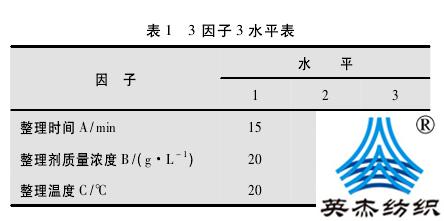
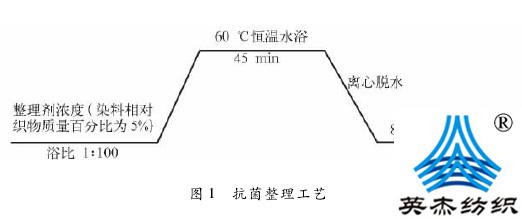
1.3 Composite finishing method The two-bath dipping method was used to sequentially perform antibacterial and anti-UV finishing on the test knitted fabric. The antibacterial finishing process is shown in Figure 1. Anti-UV finishing process: Add anti-UV agent, soak under a certain concentration of finishing agent, finishing time and finishing temperature, and then dehydrate and dry. In order to explore the impact of the anti-UV finishing process based on the antibacterial finishing process on the finishing effect, three main factors were used as finishing time A (min), finishing agent mass concentration B (g/L) and finishing temperature C (℃). Factor 3 level orthogonal test, optimized anti-UV function finishing process parameters, factor levels are shown in Table 1. 2 Performance indicators and test methods According to the anti-UV single factor test analysis, it can be seen that the anti-UV finishing process has a greater impact on the anti-82 UV performance, air permeability and drape performance of the fabric. Therefore, the ultraviolet protection factor (UPF) value, air permeability and drape were selected. These three indicators of coefficients are tested and compared.
2.1 Ultraviolet protection coefficient UPF value Use U-4100 spectrophotometer to test the ultraviolet protection coefficient UPF value of the fabric under ultraviolet irradiation of a certain wavelength (290~400nm). Referring to GB/T18830-2009, the National Textile Products Quality Supervision and Inspection Center (CTTC) carried out the UPF value of the fabric’s ultraviolet protection coefficient after 30 washes, the average UPF value, the average long-wave ultraviolet (UVA) transmittance and the average mid-wave ultraviolet (UVB) Testing and evaluation of transmittance.
2.2 Air permeability Use the YG461 fabric air permeability meter, refer to GB/T5453-1997, to test the air permeability of the fabric (sample area is 30cm2). The greater the air permeability, the better the breathability of the fabric.
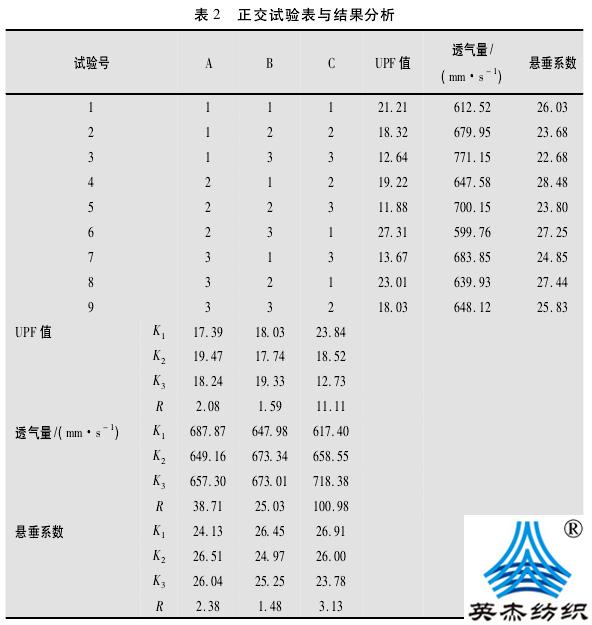
2.3 Drape coefficient Use the XDP-1 fabric drape performance tester, refer to FZ/T01045-1996, to test the drape coefficient of the fabric (circular sample with a diameter of 24cm). A small drape coefficient indicates that the fabric is soft, that is, the drape performance is good; a large drape coefficient indicates that the fabric is stiff, that is, the drape performance is poor. 2.4 Antibacterial performance refers to FZ/T73023-2006. CTTC conducts AAA level (i.e. after 50 washes) antibacterial performance testing and evaluation on fabric samples. The reference standards for bacterial species are ATCC6538 (Staphylococcus aureus), ATCC8099 (Escherichia coli) and ATCC10231 (Candida albicans). 3 Test results and analysis The orthogonal test results and analysis of the relationship between the finishing agent mass concentration A, finishing time B and finishing temperature C and the ultraviolet protection coefficient UPF value, air permeability (mm/s) and drape coefficient are shown in Table 2 Show.
It can be seen from Table 2 that among the three factors A (finishing time), B (finishing agent mass concentration), and C (finishing temperature), the order of influence factors from large to small is finishing temperature C, finishing time A and finishing agent mass concentration B. Among the three indicators of ultraviolet protection coefficient UPF value, air permeability and drape coefficient, if the ultraviolet protection coefficient UPF value is given priority, the preferred process parameter is A2B3C1, that is, when the finishing time is 25 minutes, the mass concentration of anti-UV finishing agent is 40g/ L, when the finishing temperature is 20°C, the anti-UV effect of the finished fabric is good; if the air permeability is given priority, the preferred process parameters are A2B2C3, that is, when the finishing time is 25 minutes, the mass concentration of the anti-UV finishing agent is 30g/L, and the finishing When the temperature is 80°C, the breathability of the finished fabric is good; if the drape coefficient is given priority, the preferred process parameter is A2B1C2, that is, when the finishing time is 25 minutes, the anti-UV finishing agent quality is concentrated.When the concentration is 20g/L and the finishing temperature is 50°C, the finished fabric has good drape properties.
It can be inferred from the test results in Table 2 that when the A2B3C1 scheme is selected when considering the ultraviolet protection coefficient UPF value, compared with the A2B2C3 scheme, the air permeability of the finished fabric decreases by 14.4%. Compared with the A2B1C2 scheme, the air permeability of the finished fabric decreases by 14.4%. The drape coefficient dropped by 4.3%. Considering that the anti-UV finishing effect is the primary consideration for selecting process parameters, the preferred process parameters for anti-UV composite functional finishing based on antibacterial finishing are A2B3C1, that is, the finishing time is 25 minutes, and the mass concentration of the anti-UV finishing agent is 40g/L. The finishing temperature is 20℃. The knitted fabrics finished with optimized process parameters were sent to CTTC for antibacterial and anti-UV performance testing and evaluation. The results showed that the finished cotton knitted fabrics had an inhibitory rate of 99% against Staphylococcus aureus and an inhibitory rate against Escherichia coli. The bacterial rate is 81%, and the antibacterial rate against Candida albicans is 99%, indicating that the finished cotton fabric has a good antibacterial effect;
In addition, the UPF value and average UPF value of the ultraviolet protection coefficient are both greater than 50, the average UVA transmittance is 0.4, and the average UVB transmittance is 0.1, indicating that the cotton fabric after composite finishing also has good ultraviolet protection function. ——Through orthogonal experiments, the anti-UV functional finishing process parameters of cotton knitted fabrics based on antibacterial finishing technology were optimized, namely: finishing time is 25 minutes, anti-UV finishing agent mass concentration is 40g/L, and finishing temperature is 20°C . ——The cotton knitted fabric after composite finishing with optimized process parameters has an antibacterial rate of 99% against Staphylococcus aureus, 81% against Escherichia coli, and 81% against Candida albicans. 99%, has good antibacterial function. ——The ultraviolet protection coefficient UPF value and average UPF value of the cotton knitted fabric after composite finishing with optimized process parameters are both greater than 50, the average UVA transmittance is 0.4, and the average UVB transmittance is 0.1, indicating that after finishing Cotton fabric has good UV protection. 2VVW5B
Disclaimer:
Disclaimer: Some of the texts, pictures, audios, and videos of some articles published on this site are from the Internet and do not represent the views of this site. The copyrights belong to the original authors. If you find that the information reproduced on this website infringes upon your rights, please contact us and we will change or delete it as soon as possible.
AA