
Factors affecting the UV protection performance of fabrics
Factors affecting the UV protection performance of fabrics
This article briefly describes the impact of ultraviolet rays on the human body, and specifically discusses the four factors that affect the anti-ultraviolet performance of fabrics: fiber type and morphological structure, fabric tissue structure and thickness, and dye ultraviolet shielding agents for dyeing. Two types of ultraviolet shielding agents are introduced. Mechanism of action and anti-UV finishing methods Sunlight contains a large amount of ultraviolet rays, but only 05% of the total amount can pass through the atmosphere and radiate to the ground. This is because there is an ozone layer 64 meters above the ground that can absorb a large amount of ultraviolet rays. , to protect living things on the earth from excessive ultraviolet radiation. However, with the continuous improvement of people’s living standards and the extensive use of refrigerators, air conditioners, sprays, cleaning agents, etc., the concentration of chlorofluorocarbons such as Freon in the air has increased. It is generally believed that it has caused the ozone layer to thin and even create holes, which directly leads to the increase of ultraviolet radiation on the earth’s surface.
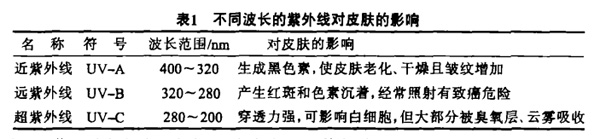
Proper exposure of the human body to ultraviolet radiation will benefit humans by sterilizing and promoting the synthesis of vitamin 7 in the body. However, excessive exposure can also cause damage to the eyes and promote the formation of cataracts, accelerate the aging of human skin and even produce cancer. Medical research shows that ultraviolet rays can damage the 7's in skin cells, causing sun spots and pigmentation. If the 7'1 cells of the epidermis are damaged too much, exceeding their repair capacity will cause skin cancer. Since the 1980s, the incidence of skin cancer has increased year by year in various places. Increasing ultraviolet rays can be divided into near ultraviolet rays, far ultraviolet rays and ultraviolet rays. 9. The main causes of damage to the human body are: Table: The impact of ultraviolet rays of different wavelengths on the skin. Name, symbol, wavelength range, impact on the skin. Near ultraviolet rays:
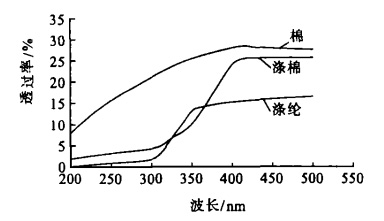
With the strengthening of people’s awareness of self-protection, how to protect the human body from ultraviolet damage has been put on the agenda. Anti-UV finishing of textiles has become a top priority. When sunlight shines on textiles, part of it is reflected, part is absorbed, and part is transmitted. The stronger the reflection and absorption of light by the fabric and the lower the ultraviolet transmittance, the stronger the protective function of the human body. The factors that affect the reflection and absorption of light by the fabric include the following aspects: fiber The type and shape structure of the three types of fabrics are cotton, polyester and polyester-cotton blended fabrics. The UV transmittance curves of cotton fabrics can be seen from the figure. The UV protection ability of polyester fabrics is stronger than that of polyester fabrics and polyester fabrics. This is Because the polyester fiber molecule contains a benzene ring structure, it has a strong absorption of ultraviolet light. Therefore, the ultraviolet transmittance is low. In the same way, the molecular structure of protein fibers such as wool and silk contains aromatic amino acids, resulting in They have good absorption of ultraviolet rays! (The following ultraviolet rays are well absorbed. Nylon, cotton and other fiber molecules do not contain aromatic ring structures, but their ability to protect against ultraviolet rays is poor. In comparison, cotton fabrics are fabrics that are easily penetrated by ultraviolet rays, and cotton fabrics are often used. The summer fabric is selected, so it needs to be properly anti-UV finishing. The cross-sectional shape of the fiber will also affect the light reflection performance. For example, polyester fiber has a circular cross-section, and wool fiber has a circular cross-section even though there is a scale layer on the surface. ,
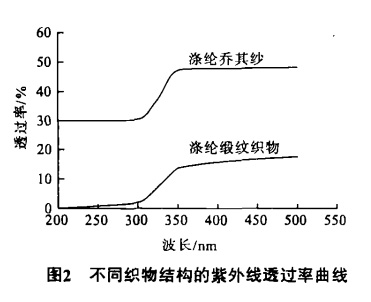
Therefore, the reflection of light is strong, which helps to reduce the transmittance of ultraviolet light. From the measurement of solar protection index/value 012, it can be seen that 3 polyester and wool have high anti-ultraviolet performance. In addition, the reduction of fiber diameter is also conducive to enhanced reflection. , so microfiber fabric has better anti-ultraviolet properties. The fabric structure and thickness of the fabric determine the porosity of the fabric. The thicker and tighter the fabric, the lower the porosity, the more light reflection, and the protection against ultraviolet radiation. The better the effect) On the contrary, if the pores of the fabric are too large, ultraviolet rays will easily penetrate and the UV protection effect will be poor. As can be seen from the figure, because the polyester satin fabric is tight and has a lower porosity than polyester georgette, its UV radiation protection effect is better than polyester. Georgette polyester satin fabric wears a single white patient gown. Mass density When a fabric is dyed dark, the ultraviolet transmittance is low. This is because the conjugate system in the dye structure selectively absorbs visible light. In addition to selectively absorbing visible light, some dyes absorb The tape also extends to the ultraviolet area, so it plays the role of ultraviolet absorber. The darker the color, the higher the dye content in the fabric, and the stronger the absorption of ultraviolet light. It is generally believed that thin, light-colored fabrics have strong heat reflection and good air permeability. , Wear cool. From the above, it can be seen that 3 such fabrics have poor anti-ultraviolet radiation effect. In summer, the sunlight exposure time is long and the ultraviolet intensity is high. Protection is needed. Therefore, just rational selection of fibers, fabric structure and dyes is not enough. Appropriate treatment is also required. Anti-UV finishing to improve the wearing properties of textiles Journal of Beijing Institute of Fashion Technology, Natural Science Edition!
UV shielding agent finishing The key to anti-UV finishing is UV shielding agent. UV shielding agent can be divided into two types according to its mode of action: one can reflect ultraviolet rays, which is called ultraviolet reflector; the other has strong absorption of ultraviolet rays and can perform energy conversion to thereby Reduce the amount of transmission: UV absorbers, UV reflectors and applications. UV reflectors can be added directly to polymers, or can be attached to the surface of fabrics by coating to achieve anti-UV properties. UV reflectors include those added to polymers. Among materials, the anti-UV polyester fiber has a particle size shorter than the wavelength of ultraviolet light, and the small size effect is significant, while the light absorption is enhanced.The small size also increases the specific surface area and improves the surface energy. When blended with polymer materials, it is easy to combine with the latter. It also meets the requirements of the spinning equipment for the particle size of the blended material and has antibacterial, mildew, and odor-proof functions. Broader application prospects. These particles are used in coating methods, which can thin the coating film while maintaining UV resistance, which is beneficial to improving the hand feel of the fabric. 1# UV absorbers and applications UV absorbers are generally organic compounds, mainly 2 Most of benzophenones and benzostrines are connected to aromatic derivatives in their molecular structures and have absorption wavelengths smaller than 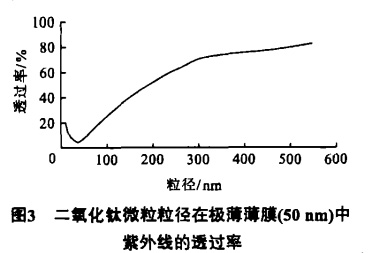
For example, after absorbing ultraviolet light, o-hydroxybenzophenone can emit fluorescence and phosphorescence like benzophenone and return to the ground state energy level. At the same time, it is also accompanied by phototautomerism of hydrogen bonding. This structure can accept Light energy can be converted into thermal energy without breaking the bonds, thereby consuming the absorbed energy as shown in the following formula 3. UV absorbers can be processed onto fabrics using high temperature and high pressure exhaustion, padding and coating methods. For polyester, nylon and other synthetic fabrics, UV absorbers can be added to the same bath for processing during high temperature and high pressure dyeing. UV absorbers The agent molecules are soluble inside the fiber. This method does not affect the feel of the fabric. Many UV absorbers are insoluble in water and lack affinity for natural fibers such as cotton and linen. Therefore, they need to be fixed on the fabric, fiber/surface with the help of resin or admixture. The process is as follows 3. The padding-drying and heat treatment coating method is to add an appropriate amount of ultraviolet absorber to the coating agent, using an applicator, such as a scraper / to apply a fine coating on the surface of the fabric, and then after drying and heat treatment, the fabric is A thin film is formed on the surface to achieve the ideal UV protection effect.
Various fibers and their blended fabrics have good processing effects and durability. Anti-UV finishing fabrics are not only used for clothing fabrics, but also for sun umbrellas, decorative fabrics, etc. For different fabrics and uses, corresponding UV shielding agents and The processing method enables the fabric to have UV protection properties while maintaining good feel, elasticity, air permeability, moisture permeability and other wearing properties or appearance effects. In summary, there are four factors that affect the UV protection performance of fabrics. The first three are only It can partially affect the UV protection performance of fabrics, but they do not need to add additional additives and do not increase the cost. UV shielding agent finishing can significantly improve the UV protection performance of fabrics, but it requires corresponding finishing methods to add UV shielding agents, which increases processing Procedures and Processing Costs Therefore, when producing UV-resistant fabrics, first consider choosing fibers and fabric structures with strong UV-resistant properties, and then consider selecting appropriate dyes. If the UV-resistant requirements have not been met, you can also use UV-shielding agents. By choosing anti-UV fiber, appropriate fabric structure and dyes, and finishing with UV shielding agent, the effect will be more ideal. I believe that as the anti-UV finishing technology continues to mature, there will be more and better anti-UV finishing products to satisfy the majority of people. Consumer demandevz0TeVFj
Disclaimer:
Disclaimer: Some of the texts, pictures, audios, and videos of some articles published on this site are from the Internet and do not represent the views of this site. The copyrights belong to the original authors. If you find that the information reproduced on this website infringes upon your rights, please contact us and we will change or delete it as soon as possible.
AA