
Research on the dyeing and finishing process of silver-based antibacterial polyester and bamboo pulp fiber knitted blended fabrics
Research on the Dyeing and Finishing Technology of Silver Antibacterial Polyester Bamboo Pulp Fiber Knitted Blended Fabric
Silver antibacterial polyester/bamboo pulp knitted blended fabric is made of silver antibacterial polyester fiber with excellent antibacterial properties and bamboo pulp fiber. Therefore, the fabric has good antibacterial properties. In order not to affect the antibacterial properties of the knitted fabric, the The pre-treatment process and dyeing process have been optimized, but the antibacterial performance has still declined. For this reason, this article uses antibacterial finishing agents to post-process the fabrics, and discusses in detail the effects of antibacterial agent dosage, treatment temperature, and treatment time on the antibacterial rate. The results show that after finishing, the antibacterial performance of the fabric reaches more than 99%.
1 Introduction
With the development of society and economy, people have higher and higher requirements for the quality of life, and pay more attention to environmental safety and antibacterial hygiene related to physical health. Under the influence of this general trend, antibacterial textiles have emerged as the times require. . By blending silver-based antibacterial polyester fiber with bamboo pulp fiber with excellent antibacterial properties, knitted fabrics with antibacterial functions can be obtained. However, after pre-treatment and dyeing, the antibacterial properties are reduced. In order not to affect the antibacterial performance of the fabric and facilitate more scientific antibacterial finishing of the fabric, this article will discuss the impact on the antibacterial rate from three aspects: antibacterial agent dosage, treatment time and treatment temperature.
2 Experimental part
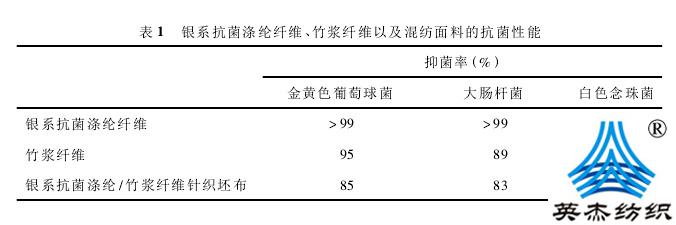
2. 1 Sample cloth and reagent antibacterial polyester/bamboo pulp blended knitted fabric (50 /50, 34S, 140 ~ 150g /m2); hydrogen peroxide, sodium silicate, sodium carbonate, disodium hydrogen phosphate, acetic acid, Yuanming powder and insurance powder, etc., are all analytically pure reagents; water softeners, degreasing agents and antibacterial finishing agents, etc., are all industrial grade. Among them, silver-based antibacterial polyester/bamboo pulp fiber fabric is blended from 50% silver-based antibacterial fiber and 50% bamboo pulp fiber with certain antibacterial properties [1]. It is worth noting that during the blending process of silver-based antibacterial polyester fiber and bamboo pulp fiber, antistatic agents and other additives are added, which reduces the antibacterial properties of the silver-based antibacterial polyester/bamboo pulp fiber knitted gray fabric. Table 1 shows the antibacterial properties of silver-based antibacterial polyester fiber, bamboo pulp fiber and knitted fabrics blended with the two.
2. 2 Dyes include AC-E (Dystar) and Kehuatai Brilliant Red 3BSN.
2. 3 Instruments and equipment: JF8383 overflow dyeing machine, WS-500 P rope dyeing and washing machine (Japan), R-3 styling dryer, Y571B rubbing color fastness instrument and SW12B water fastness tester, etc.
2. 4 Experimental methods
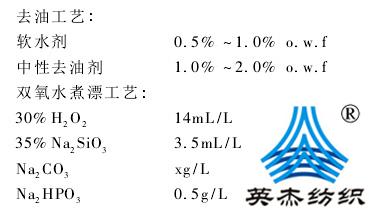
2. 4. 1 Pretreatment process Since bamboo pulp fiber has poor alkali resistance and oxidation resistance [2], and the antibacterial property of silver antibacterial polyester fiber in alkaline medium will be affected to a certain extent [3], so pretreatment Using sodium carbonate instead of sodium hydroxide allows oil and pigments to be removed under milder process conditions. This not only ensures the removal rate, but also keeps the strength of the fabric unaffected.
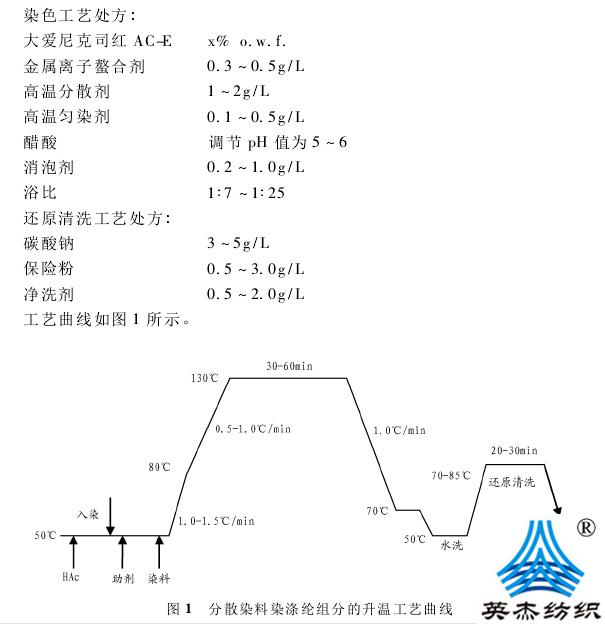
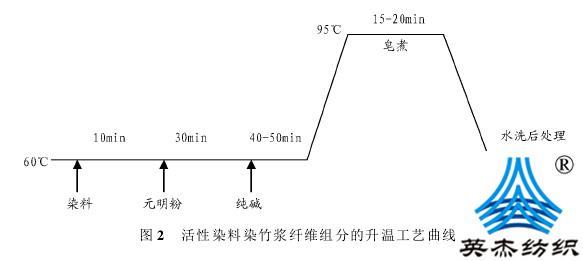
2. 4. 2 Dyeing process [4] Since the fabric is a two-component blended product, in order to achieve good dyeing effects, a two-bath and two-step method of disperse and reactive dyes is used. The antibacterial polyester is first dyed with disperse dyes. After reduction cleaning, the bamboo fiber component is over-dyed with reactive dyes, and sodium carbonate is used for color fixation reaction.
2. 4. 2. 1 High temperature and high pressure dyeing of polyester components with disperse dyes
2. 4. 2. 2 Components of reactive dyes for overdying bamboo pulp at normal temperature and pressure
2. 4. 3 Finishing process
After pre-treatment and dyeing, the antibacterial performance of silver-based antibacterial polyester/bamboo fiber knitted blended fabrics is seriously reduced. Therefore, in order to ensure good antibacterial effect of the fabric, a small amount of antibacterial agents need to be added in the post-finishing process.
3 Results and Discussion
3. 1 Pretreatment according to 2
. The boiling and bleaching process described in 4.1 is pre-treated, and its impact on the whiteness, strength and antibacterial properties of the fabric is shown in Table 2.
It can be seen from Table 2 that as the sodium carbonate concentration increases, the whiteness of the silver antibacterial polyester/bamboo pulp fiber knitted blended fabric gradually increases, but at the same time, the bursting strength of the fabric continues to decrease, and the blended fabric The antibacterial rate also dropped sharply. Generally speaking, pretreatment mainly uses the combined action of alkali and hydrogen peroxide to remove slurry, pigments, oils and some natural impurities on the surface of the fabric, so that the fabric obtains a clean appearance and good feel [5]. Although increasing the alkali concentration is beneficial to the pre-treatment of the fabric, it will damage the strength of the fabric. Therefore, after comprehensive consideration, it is believed that the concentration of sodium carbonate should not be too high and should generally be controlled at around 1g/L. After dyeing according to the dyeing process described in 2.4.2, the color fastness and antibacterial properties of the silver antibacterial polyester/bamboo pulp blended knitted fabric are shown in Table 3 and Table 4 respectively.
Compared with the antibacterial properties of silver-based antibacterial polyester/bamboo pulp fiber knitted gray fabrics in Table 1, the antibacterial properties of the dyed fabrics (see Table 4) decreased by approximately 40% to 50%, although the dyeing process uses a weak alkali process, and The amount of alkali agent has also been reduced, but the antibacterial properties of the fabric are still greatly affected by alkali and other additives.
3.3 Finishing
3. 3. 1 Selection of antibacterial finishing agents The antibacterial finishing agents produced by Beijing Zhongfang Chemical Co., Ltd., Beijing Jieershuanggao and Hute International Group were used for post-treatment of the fabrics. Silver antibacterial polyester/bamboo pulp blended fabrics were used. The antibacterial rate of knitted fabrics after washing 20 times is shown in Table 5.
It can be seen from Table 5 that after the silver antibacterial polyester/bamboo pulp blended knitted fabric was post-treated with antibacterial finishing agents from the three companies, the antibacterial rate was significantly improved compared with before dyeing; however, after 20 times of washing, Beijing The washing resistance of Zhongfang Chemical’s antibacterial finishing agent is slightly better than that of the other two companies. Based on comprehensive considerations, this article selected the antibacterial finishing agent produced by Beijing Zhongfang Chemical Co., Ltd.
3. 3. 2 Optimization of antibacterial process The impact of antibacterial agent dosage, treatment temperature and treatment time on the antibacterial rate is shown in Figure 3.
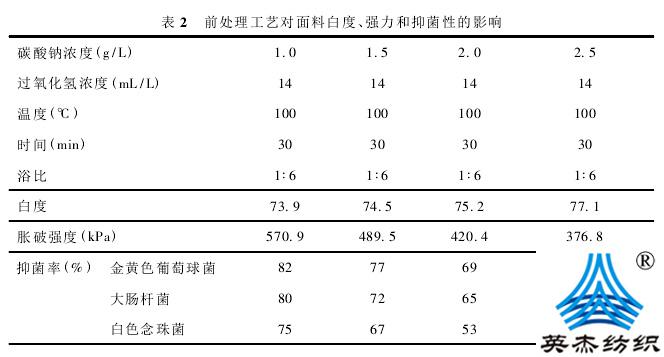
Figure 3 shows that as the dosage of antibacterial agent increases, the antibacterial effect increases in a linear relationship; when the dosage of antibacterial agent reaches 0. 6% o.w.f, the antibacterial rate is close to 100%, and after 20 times of washing, the antibacterial effect The antibacterial rate can still reach more than 89%, and some antibacterial indicators are even above 99%; when finishing between 40 and 60°C, the affinity between the antibacterial agent and the bamboo pulp fiber is good, and the antibacterial rate reaches a maximum; and When the temperature is lower or higher than this range, the bacteriostatic agent and fiber cannot react completely, or other side reactions occur, resulting in a decrease in the bacteriostatic rate; as the post-finishing time prolongs, the bacteriostatic rate gradually approaches balance. After 30 minutes of post-finishing, the antibacterial rate no longer changed significantly, which indicated that the reaction between the antibacterial agent and the fiber was nearly complete, and the extension of time had no obvious effect on the increase in the antibacterial rate. To sum up, when 0. 6% o.w.f is used for antibacterial post-treatment of fabrics for 30 minutes between 40 and 60 ℃, the antibacterial properties of the fabrics can reach more than 99%.
3. 4 Antibacterial effect After pre-treatment, dyeing and finishing, the antibacterial performance of silver antibacterial polyester/bamboo pulp fiber knitted blended fabric is shown in Table 6.
Conclusion
Due to the role of silver and bamboo pulp fiber, the silver-based antibacterial polyester/bamboo pulp fiber knitted blended fabric itself has good antibacterial properties. However, due to the alkali agent in the pre-treatment and dyeing process, the antibacterial rate of the fabric has decreased. . This article adds a small amount of antibacterial agents during the post-finishing process. The results show that after antibacterial finishing, the antibacterial rate of silver antibacterial polyester/bamboo pulp fiber knitted blended fabrics against Staphylococcus aureus, Escherichia coli and Candida albicans reaches 99% % or more, it has excellent antibacterial properties; compared with before the dyeing and finishing process, the antibacterial properties are almost the same.
Disclaimer:
Disclaimer: Some of the texts, pictures, audios, and videos of some articles published on this site are from the Internet and do not represent the views of this site. The copyrights belong to the original authors. If you find that the information reproduced on this website infringes upon your rights, please contact us and we will change or delete it as soon as possible.
AA