
How are trypsin and BF-enzyme used in the desizing process? What are the requirements for each?
Answer: Trypsin and BF-7658 enzyme are both amylase, and these two enzymes can be used together to desize fabrics with starch as sizing. However, due to the different properties of the two enzymes, there are certain differences in their use. The details are as follows.
Pancreatin is an extract of animal pancreas, generally extracted from pig pancreas and bovine pancreas. The suitable temperature for trypsin is 40-55℃, and it can be completely destroyed at 65-70℃. Within the range of pH=6.8~7.3, its activity and stability can be balanced; when pH=4, it loses its activity greatly; when pH=11.5, it has high activity, but it is easily destroyed. Trypsin has poor stability and should generally be used up within 2 hours after being prepared into a solution. It is generally better to use 1.55g/L salt as an activator.
BF-7658 enzyme is a type of bacterial amylase, a protein-like organism secreted by Bacillus subtilis. Generally, the activity is higher at 40~80℃, and the suitable temperature is 65℃. When pH=5, the desizing rate can reach 80%. When the pH value is 6 to 7, the high desizing rate is 85%. BF–7658 enzyme is destroyed in strong acid and strong alkali. Heavy metal ions such as Fe3+, Cu2+, Zn2+, and Hg+ can passivate enzymes and inhibit enzyme activation, so metal utensils cannot be used in the desizing tank. At the same time, salt or CaCl2 can improve the activation of the enzyme and make the enzyme more stable at high temperatures. The activity of BF-7658 enzyme is inhibited when it comes into contact with fat soap and powder. If the tap water contains too much free chlorine, it will also be detrimental to the enzyme. When using it, you should avoid contact with various harmful substances. The dosage of enzyme should be determined based on the desizing process (insulation stacking method, high temperature steaming method, hot bath method, etc.), the pulp content of natural cotton cloth, and the conversion rate of amylase. The specific desizing process is shown in Table 2-1. 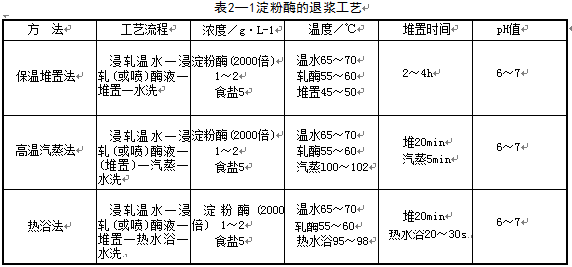
Note: If using trypsin, the enzyme temperature should be 40℃ and soaked in water The temperature and stacking temperature decrease accordingly.
AAASDFERGTRHR
Disclaimer:
Disclaimer: Some of the texts, pictures, audios, and videos of some articles published on this site are from the Internet and do not represent the views of this site. The copyrights belong to the original authors. If you find that the information reproduced on this website infringes upon your rights, please contact us and we will change or delete it as soon as possible.
AA